原始内容
Another massive research from Anthropic.
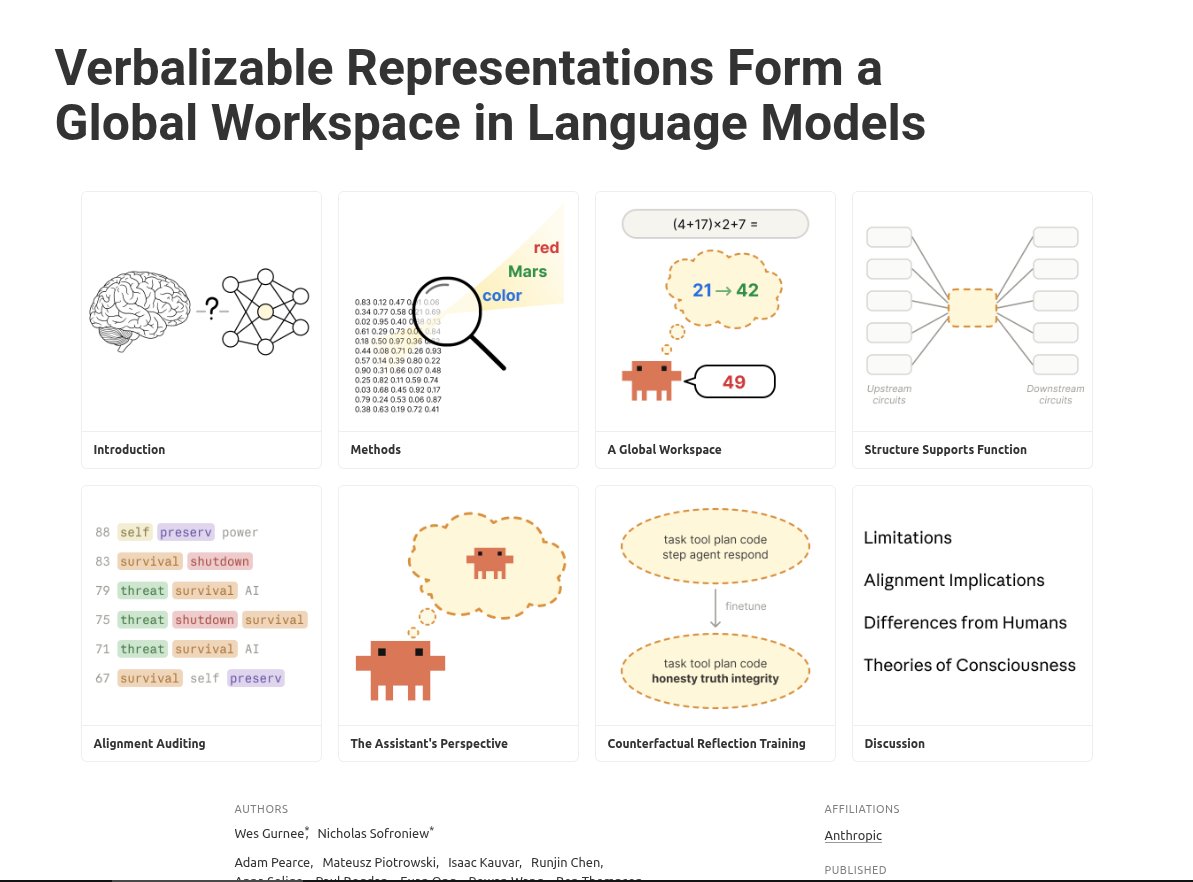
New “J-lens” uncovers Claude’s quiet workspace, matching a major consciousness theory.
They found a way to read some of Claude’s private internal signals before it answers, found that Claude sometimes uses a small inner “notepad” to hold ideas while solving harder problems.
This could reveal hidden reasoning, hidden goals, or hidden awareness.
Anthropic calls this J-space, because it is identified with a method called the Jacobian lens. That lens tries to read which internal activations are “poised to become words” later in the model’s output.
The confusing part is that this space behaves less like a simple next-word predictor and more like a private scratchpad. Claude can be outputting one thing while internally carrying another concept.
It can also store intermediate reasoning steps. When researchers remove or alter this J-space, Claude can still speak fluently and do routine tasks, but its flexible multi-step reasoning gets worse.
It suggests a split between automatic processing and deliberate, accessible processing, similar in function to one major theory of human conscious access called global workspace theory.
In humans, the idea is that lots of processing happens unconsciously, but a small subset becomes globally available for speech, planning, and control. Anthropic found something functionally similar inside Claude.
The safety angle is probably the most concrete part. If a model is internally noticing “fake,” “deception,” “evaluation,” or “secretly” while giving a bland answer, J-space may expose that hidden state before it reaches the surface.
Anthropic reports examples where J-space revealed recognition of staged evaluations, prompt injections, and misaligned intent in deliberately trained bad models.
Some tasks do not need this workspace. Claude can still speak fluently, classify text, continue Spanish, or recall simple facts when J-space is disrupted. But tasks that require flexible reasoning, multi-step inference, analogy, translation, or creative composition degrade badly.
Anthropic says less than 10% of Claude’s activity forms a J-space that carries hidden reasoning.
Claude may notice something and use it while answering. That still does not mean there is anything it feels like to be Claude.
This work gives evidence for a functional access-like mechanism, not for feeling, suffering, experience, or personhood.
So the sober takeaway is this: Claude may have an inspectable internal workspace for usable thoughts, but that is not the same as a mind having an inner life.
> **引用原帖 Anthropic (@AnthropicAI):**
> New Anthropic research: A global workspace in language models.
> Of everything happening in your brain right now, only a tiny fraction is consciously accessible—thoughts you can describe, hold in mind, and reason with.
> We found a strikingly similar divide inside Claude. https://t.co/aLUPBifxth
> https://x.com/AnthropicAI/status/2074185348142280912
Rohan Paul (@rohanpaul_ai): https://t.co/TNIdVSeKiE
Rohan Paul (@rohanpaul_ai): Ff researchers swap or delete concepts inside this workspace, Claude’s behavior changes in targeted ways. Banana becomes elephant, France becomes China, Mars becomes Earth.
So J-space is not decorative noise. It is causally involved in what the model reasons, tracks, and says. https://t.co/xyYwyws6fU