一句话判断
删除 80% 系统提示后仍保持评测性能,为后续模型提示优化提供可操作经验。
核心信息
Anthropic 团队在 Claude Code 新模型中删除了约 80% 的系统提示,结果在编码评测中未出现负面影响。此前的长提示包含了严格规则(如禁止多行注释),但与模型自主决策相冲突。新的提示改为仅描述目标,即编写与现有代码匹配的代码,并将规则迁移至工具描述,减少重复与前置加载,提升上下文效率。
原始内容
A great piece from Thariq (Anthropic) - "The new rules of context engineering" in Claude.
Anthropic removed over 80% of the system prompt for Claude Code and saw no negative impact on its coding evaluations.
There was a reason the old prompt was long : early models needed strict guidelines to prevent file deletions or unprofessional comments.
The team therefore wrote strict rules, such as not writing multi-line comment blocks, and recognized that the rule would sometimes be wrong.
But when the new models could figure out a situation and make their own decisions, that tradeoff didn’t make sense anymore.
To make matters worse, these old rules began to clash with each other : a skill might tell the user not to add comments, while the user asks about documentation.
Claude can still figure out what you mean, but his thinking goes off on tangents reconciling instructions instead of solving your real problem.
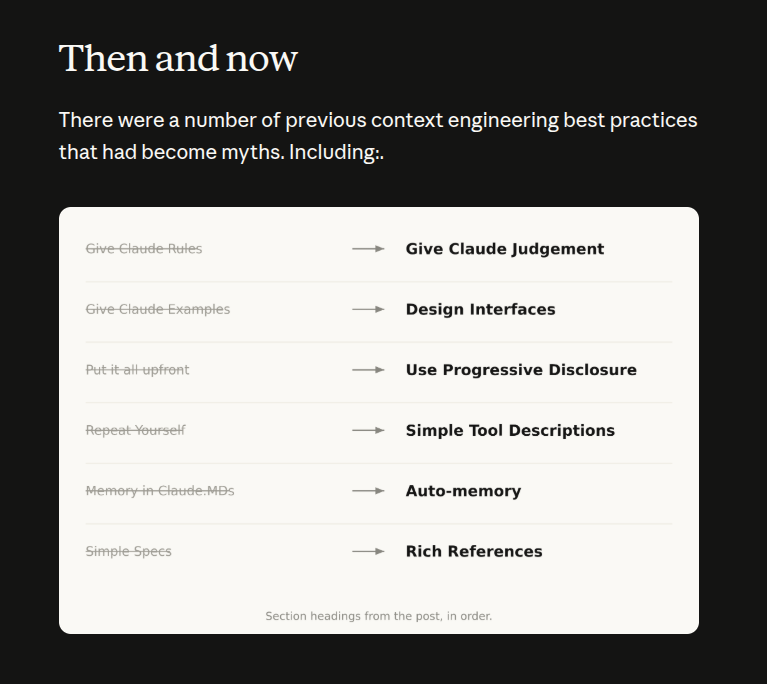
The fix was to delete the rules and describe the goal, so the new prompt simply says write code that matches the surrounding code.
The same logic subsequently permeated the whole of the context.
While previous best advice for tool use has been examples, the model is now forced to copy the example instead of exploring.
It is better to design the tool itself, since a status field limited to pending, in_progress and completed shows proper usage without a single example.
Front-loading has also been eliminated due to the inclusion of code review and verification in skills that are only turned on when needed.
Some tools are hidden until the agent discovers them, meaning they don’t need any context until they’re needed.
The same was true for repetition, since instructions are now in tool descriptions rather than repeated in the system prompt.
Your CLAUDE .md no longer has to be a notebook, memory saves itself automatically.
Short. Tokens into gotchas not obvious from the repo. Rest into skills.
The result was more comprehensive references; a test suite, an HTML mockup or a rubric conveys more information than a paragraph of description.
Prompt bloat now functions like technical debt: every guardrail you build for a less-capable model will still be a cost to you on a more capable one.
What really changed is that context engineering went from writing rules to building how well the model can read.

> **引用原帖 Thariq (@trq212):**
> We removed ~80% of the Claude Code system prompt for our newest models, this is what we've learned about writing system prompts, skills and Claude.MDs for them. https://t.co/6DZwSrZjE9
> https://x.com/trq212/status/2080710971228918066
相关动态
01
Induction Labs 发布 Photon-1 想象模型
Induction Labs 发布想象模型 Photon-1,该模型通过在潜空间学习 18 年屏幕录制视频的因果关系且无需动作标签,采用 JEPA 架构,预训练成本声称比 Gemini 3.1 Flash 低 30 倍且效果更优,动作仍需后训练 RL 习得。
观察
02
Anthropic 删除 Claude Code 80% 系统提示影响模型表现
Anthropic 在 Opus 5 / Fable 5 模型中删除了 Claude Code 80% 以上的系统提示,发现新模型能更好地利用上下文与自我判断,表现更佳。Fable 5 依据此经验,将 indigo-mind 知识库 CLAUDE.md 从 10.2k 压缩到 6.5k,同时保留了部分重要内容。
值得跟进
03
SK Group and NVIDIA announce $500B+ AI initiative
SK Group与NVIDIA宣布超5000亿美元合作计划,包括在韩国建设2吉瓦的NVIDIA Vera Rubin DSX AI工厂,以及SK海力士与NVIDIA共同开发下一代AI内存(含HBM)。
值得跟进
04
GPT-5.6 Sol Ultra 破解量子密码学难题
GPT-5.6 Sol Ultra 通过 Codex 生成了构造方案和主要证明思路,协助人类专家解决了量子密码学领域一个存在六年的未解之谜。
观察
05
Kimi K3 性能接近 Claude
Moonshot AI 的 Kimi K3 在 DeepSWE 基准上与 Anthropic 的 Claude Fable 5 性能接近,单次任务成本约为后者的三分之一,在多次尝试场景下实现超越。
观察