AI 精选动态
智能评分 78
美国AI基建面临许可限制,中西南地区对数据中心设施反对最强
AI 推荐理由
需关注实际落地规模与技术落地成效,二次转述需补充原文提到的具体反对政策名称及州名核心解读
美国50个州及地方政府对数据中心设置了超过300项禁止或暂停令,其中275项已通过,75项仍在审议中;行业面临地理限制,但新一代数据中心通过闭环冷却和核能能源协同解决用水、用电问题。技术进展包括微软AI芯片级冷却系统年节水量达1.25亿升,谷歌数据中心电力效率(PUE)达到1.09,比行业平均水平低1.56。此前分析显示数据中心运营可能降低网络用电费用。
全文
The U.S. AI buildout is running into a harder constraint than GPUs: permission.
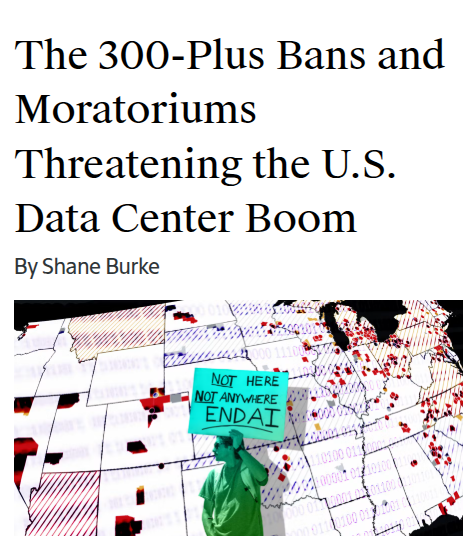
The Information’s new map finds 300+ state and local data-center bans or moratoriums since 2023, with 275+ passed this year and 75+ still under consideration; resistance is strongest in the Midwest and South, exactly where hyperscalers want cheap land and megawatt-scale power.
But the backlash against data centers is outrunning the facts.
The most current datacenter is increasingly designed to solve the two biggest fears: water and power bills.
Start with water. Microsoft’s next-generation AI data centers use chip-level, closed-loop cooling that consumes zero water for cooling and can avoid more than 125 million liters per year per site.
Its fleetwide water-use efficiency has already improved 39% since 2021, to 0.30 liters per kWh.
Google reports that 86% of its freshwater withdrawals come from low- or medium-risk sources, and its global data-center fleet runs at a 1.09 PUE versus a 1.56 industry average—meaning far less wasted overhead energy.
Electric bills are not automatically shifted to households, either. A recent causal study of U.S. retail rates from 2015–2024 found data centers modestly lowered average rates by spreading fixed grid costs across more electricity sales.
And “bring your own power” is already the new trend - e.g. Google’s 500 MW nuclear deal, Microsoft’s 835 MW Three Mile Island agreement, and Meta’s 1,121 MW nuclear contract.

Rohan Paul (@rohanpaul_ai): https://t.co/7saab0ZI5V
https://t.co/fHYqZR2Y25